
Memory Is Not Passive
Why Standing With Danny Finkelstein Matters Now More Than Ever

There is a particular danger in the modern world that is often overlooked. It is not simply that hatred exists - hatred has existed in every era. The real danger is how easily societies convince themselves that certain forms of hatred are no longer serious. That they belong to another time. That they are theatrical, ironic, or merely provocative rather than dangerous.
I recently read a piece in The Times by Danny Finkelstein talking about attacks directed at him following his criticism of extremist commentator Nick Fuentes. What might appear to some as just another ideological skirmish online is, in reality, a deeply familiar historical pattern: antisemitism resurfacing through distortion, denial and wilful historical amnesia.
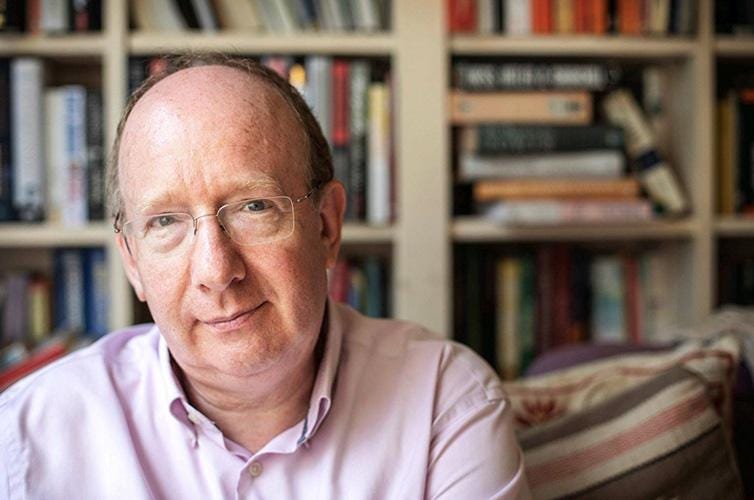
Supporting Finkelstein is not about defending a columnist or engaging in partisan debate. It is about defending historical truth against those who would rather reshape the past to legitimise prejudice in the present.
Finkelstein’s authority on antisemitism is not purely intellectual. It is deeply personal. His memoir, Hitler, Stalin, Mum and Dad, is one of the most powerful historical testimonies published in recent years, precisely because it refuses to allow twentieth-century totalitarian horrors to become abstract.
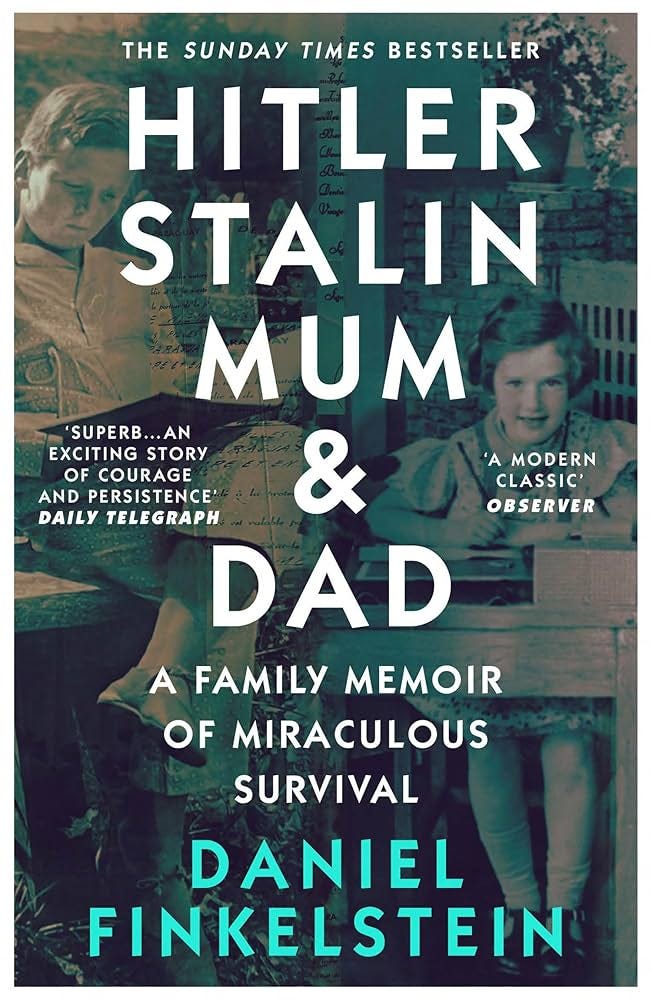
Through the intertwined experiences of his parents’ families, one devastated by Nazi persecution, the other shattered by Stalinist repression, Finkelstein illustrates something that ideological extremists often rely on people forgetting: genocide and political persecution do not begin with violence. They begin with language, stereotypes, conspiracy theories and the steady erosion of empathy.
Reading his book is a reminder that history is not a sequence of distant tragedies but a collection of individual lives extinguished by ideas that, at their inception, were often dismissed as fringe or rhetorical.
It is perhaps unsurprising, then, that those who seek to minimise or recycle antisemitic narratives find voices like Finkelstein’s inconvenient. Personal testimony collapses ideological fantasy. It transforms statistics into human beings. It makes denial harder and distortion more obvious.
One of the most striking aspects of modern antisemitism is how little it has changed. Across centuries and across political ideologies, it has relied on remarkably consistent themes: accusations of secret Jewish power, suggestions of collective guilt, and the portrayal of Jewish communities as existential threats to national or cultural identity. Figures like Fuentes present themselves as challengers of establishment narratives, yet their rhetoric is built almost entirely from recycled propaganda. There is nothing radical about repeating claims that have been used to justify expulsions, pogroms and genocide for hundreds of years.
The digital age has merely accelerated the spread of these ideas. Social media has created ecosystems where historical ignorance can be amplified, reinforced and insulated from scrutiny. Within such environments, antisemitism is frequently repackaged as irony, humour or intellectual rebellion. But history shows that prejudice rarely announces itself openly at first. It evolves gradually, often cloaked in cultural or political commentary.
In the weeks leading up to Holocaust remembrance events this year, the Chief Rabbi Ephraim Mirvis warned that antisemitism was not only persisting but evolving. His message was not ceremonial. It was a direct appeal to recognise that prejudice rarely reappears in identical form. It adapts to contemporary language, contemporary platforms and contemporary grievances.
The most dangerous misunderstanding about Holocaust remembrance is the belief that it exists solely to honour the dead. While remembrance certainly serves that purpose, it also functions as a warning system. It teaches societies to recognise early indicators of hatred before they escalate into violence.
The historical record is devastatingly clear. Antisemitism doesn't begin with concentration camps or mass violence. It begins with rhetorical normalisation. It begins with suggestions that Jews possess undue influence. It begins with accusations that Jewish identity is inherently subversive or parasitic. It begins with the slow social acceptance of language that reduces individuals to caricatures.
Every stage of that progression has repeated throughout history, and every stage was accompanied by voices arguing that the threat was exaggerated.
One of the most common defences of extremist rhetoric is the argument that it is merely speech. That it is provocative but ultimately harmless. That confronting it represents censorship rather than accountability. This argument collapses under historical scrutiny.
Antisemitism possesses a uniquely documented trajectory from rhetoric to violence. Nazi propaganda did not emerge fully formed. It developed over decades through newspapers, political speeches, caricatures and cultural narratives that normalised hostility toward Jewish communities. By the time state-sponsored violence began, much of the ideological groundwork had already been accepted by large segments of society.
Recognising this pattern does not require abandoning principles of free speech. It requires acknowledging that speech has consequences and that societies have a moral responsibility to challenge demonstrably false and dangerous narratives.
Calling antisemitism what it is does not restrict debate. It strengthens it by insisting that arguments be grounded in evidence rather than conspiracy theory.
Extremist movements frequently attempt to undermine or relativise survivor testimony and family histories because they disrupt ideological narratives. Statistics can be manipulated or dismissed. Personal stories are harder to erase.
Finkelstein’s work stands as a reminder that behind every historical statistic lies a family, a culture and a future that was destroyed. His parents’ experiences illustrate that totalitarian regimes rarely target a single group in isolation. Hatred often expands outward, consuming political opponents, minorities and anyone who challenges authoritarian orthodoxy. This broader historical perspective is crucial. Antisemitism is never only about Jews. It is a warning sign of societies drifting toward broader intolerance and authoritarianism.
The phrase “Never Again” is often repeated during Holocaust remembrance events. Yet its meaning is frequently misunderstood. It is not a prediction. It is a responsibility.
Memory alone cannot prevent hatred. Memory must be accompanied by vigilance, education and the willingness to confront prejudice in its earliest forms. That responsibility does not rest solely with Jewish communities or historians. It belongs to anyone who values democratic pluralism and historical truth.
Standing with voices like Finkelstein’s is therefore not an act of political allegiance. It is an act of historical literacy. It is a recognition that societies often slide into intolerance gradually, through normalised rhetoric and cultural complacency rather than sudden radical transformation.
History repeatedly demonstrates that silence is prejudice’s most reliable ally. Antisemitic narratives rarely dominate immediately. They grow incrementally, nourished by indifference and rationalised as harmless provocation. Challenging such narratives early is uncomfortable. It invites backlash and accusations of overreaction. Yet the historical alternative - waiting until prejudice manifests as violence - carries far greater moral and human consequences. Finkelstein’s willingness to confront extremist rhetoric despite predictable personal attacks reflects a form of public courage that historical memory demands. It is easier to remain silent. It is easier to dismiss online extremism as fringe theatre. It is also historically dangero
The persistence of antisemitic rhetoric in modern political discourse represents a test of societal memory. The twentieth century provided overwhelming evidence of where such hatred can lead. The question confronting contemporary societies is whether that evidence will be taken seriously or gradually dismissed as distant history.
The digital age has shortened attention spans but has not shortened historical consequences. Ideas still shape behaviour. Language still influences policy. Conspiracy theories still create environments in which violence can be rationalised. Supporting those who challenge antisemitism is therefore not simply an ethical gesture. It is a practical defence of historical truth and democratic values.
The true purpose of remembrance is not reflection alone but prevention. It is the recognition that history is not safely contained in textbooks or memorial ceremonies. It is an ongoing dialogue between past experience and present behaviour.
Danny Finkelstein’s writing, rooted in family testimony and historical scholarship, forces readers to confront that dialogue honestly. His willingness to speak openly about antisemitism is not only courageous but necessary. It reminds society that historical memory is fragile and that defending it requires active participation.
If remembrance is to mean anything, it must extend beyond annual ceremonies. It must shape how societies respond to prejudice in real time. It must encourage individuals to challenge narratives that distort history or dehumanise communities.
Because history shows, repeatedly and tragically, that hatred rarely announces itself as catastrophe. It begins quietly, dressed as commentary, irony or intellectual provocation. And it survives only when enough people decide not to challenge it. For this we need to thank people like Danny Finkelstein for his honesty, integrity and bravery on standing up to and confronting recyclers of hate and conspiracy like Nick Fuentes.
I don’t pretend to have every answer to the issues raised here, but I do believe these are conversations worth having. The rise of prejudice, the importance of memory and the responsibility we carry as witnesses to history are questions that benefit from open and honest dialogue. If this piece has resonated with you,whether you strongly agree, respectfully disagree, or simply want to explore the topic further, I would very much value hearing your thoughts. Substack has always felt like a space for genuine discussion rather than shouting into the void, and I welcome anyone who wishes to engage with these ideas in good faith to reach out or join the conversation. Message me below or my email is wayne.chadburn@outlook.com